
Hyundai Genesis (DH): Air Conditioning System / Condenser Repair procedures
| Inspection |
| 1. |
Check the condenser fins for clogging and damage. If they are
clogged, clean them with water, and blow them with compressed air. If
they are bent, gently bend them using a screwdriver or pliers. |
| 2. |
Check the condenser connections for leakage, and repair or replace it, if required.
|
| Replacement |
| 1. |
Recover the refrigerant with a recovery/recycling/charging station. |
| 2. |
Disconnect the negative (-) battery terminal. |
| 3. |
Remove the engine room cover.
(Refer to Engine Mechanical System - "Engine room cover") |
| 4. |
Remove the front strut bar (A).
|

| 5. |
Remove the air cleaner assembly.
(Refer to Engine Mechanical System - "Air cleaner") |
| 6. |
Disconnect the radiator upper hose.
(Refer to Engine Mechanical System - "Radiator") |
| 7. |
Remove the upper mounting bracket.
(Refer to Engine Mechanical System - "Radiator") |
| 8. |
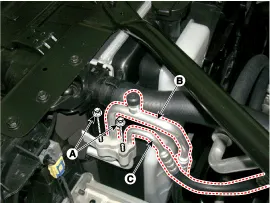
Remove the nuts (A), and then disconnect the discharge line (B) and liquid line (C) from the condenser.
|
| 9. |
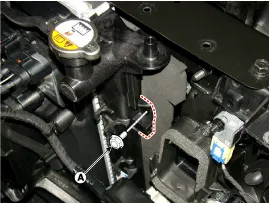
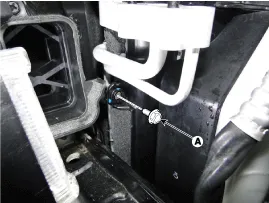
Remove the bolts (A), and then disconnect the condenser.
[LH]
[RH]
|
| 10. |
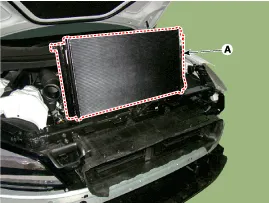
Pull the condenser (A) rearward and then pull it upward to remove it.
|
| 11. |
Install in the reverse order of removal.
|

