
Hyundai Genesis (DH): General Information / Repair procedures
| Service Adjustment Procedure |
| 1. |
Turn the steering wheel so that the front wheels are placed in the straight ahead position |
| 2. |
Measure the distance that the steering wheel is turned until the front wheels move.
|
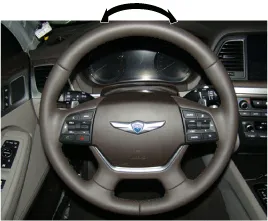
| 3. |
If the play exceeds standard value, inspect the steering column, shaft, and linkages. |
| 1. |
Position the vehicle on level ground and place the steering wheel in the straight ahead position. |
| 2. |
Start the engine and turn the steering wheel from lock to lock several times to warm up the power steering fluid. |
| 3. |
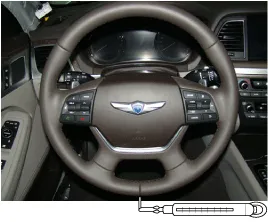
Attach a spring scale to the steering wheel. With the engine
speed of 900 to 1100rpm, pull the scale and read it as soon as the
wheels begin to turn.
|
| 4. |
If the measured value exceeds standard value, inspect the power steering gear box and pump. |
Troubleshooting SymptomCause of the symptomRemedyExcessive play in steeringLoose U-joint boltRetighten or replace as necessaryLoose yoke plugRetightenLoose steering gear mounting boltsRetightenLoose or worn tie rod endRetighten or replace as necessarySteering wheel does not return to its original positionExcessive turning resistance of tie rod endReplaceYoke plug excessively tightAdjustTie rod and/or ball joint cannot turn smoothlyReplaceLoose mounting of gear box mounting bracket at the subframeRetightenWorn steering shaft joint and/or body grommetCorrect or replaceDistorted rackReplaceRattling or chucking noise in the rack and pinionLoose steering gear box mountingRepositionLoose tie rod end and/or ball jointRetightenWorn tie rod and/or ball jointRetightenLoose yoke plugReplace
Other information:
Hyundai Genesis (DH) 2013-2016 Service Manual: Rheostat Repair procedures
Inspection 1. Disconnect the negative (-) battery terminal. 2. Remove the crash pad lower panel. (Refer to Body - "Crash Pad Lower Panel") 3. Remove the lower crash pad switch assembly (A) after disengaging the mounting clip. 4. Remove the rheostat switch connector (A).
Hyundai Genesis (DH) 2013-2016 Service Manual: Auto Defogging Sensor Description and Operation
Description The auto defogging sensor is installed on the front window glass. The sensor judges and sends signal if moisture occurs to blow out wind for defogging. The air conditioner control module receives signal from the sensor and restrains moisture and eliminate defog by controlling the intake actuator, A/C, auto defogging actuator,
Categories
- Manuals Home
- Hyundai Genesis Owners Manual
- Hyundai Genesis Service Manual
- Parking Assist Sensor Repair procedures
- Suspension System
- Electric Parking Brake (EPB) Repair procedures
- New on site
- Most important about car
