Hyundai Genesis (DH): Cylinder Head Assembly / Cylinder Head Cover Repair procedures

Removal
LH Cylinder Head Cover
1.
Disconnect the battery "-" terminal from the trunk room.
2.
Remove the surge tank.
(Refer to Intake And Exhaust System - "Surge Tank")
3.
Remove the intake manifold.
(Refer to Intake And Exhaust System - "Intake Manifold")
4.
Remove the high-pressure fuel pipe.
(Refer to Fuel system - "delivery pipe")
5.
Remove the LH ignition coil and wiring.
(Refer to Engine Electrical System - "Ignition Coil")
6.
Remove the high pressure fuel pump.
(Refer to Engine Control / Fuel System - "High Pressure Fuel Pump")
7.
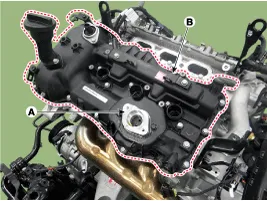
Remove the LH cylinder head cover.
(1)
Remove the LH exhaust CVVT oil control valve (OCV) cap (A).
(2)
Remove the LH cylinder head cover (B).

   
Cover the cylinder head with a piece of clean cloth or vinyl cover to prevent foreign materials from entering the cylinder head.
RH Cylinder Head Cover
1.
Disconnect the battery "-" terminal from the trunk room.
2.
Remove the surge tank.
(Refer to Intake And Exhaust System - "Surge Tank")
3.
Remove the RH ignition coil and wiring.
(Refer to Engine Electrical System - "Ignition Coil")
4.
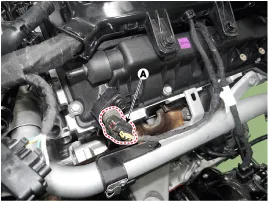
Remove the RH exhaust CMP sensor connector (A).

5.
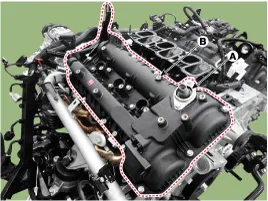
Remove the RH cylinder head cover.
(1)
Remove the RH exhaust CVVT oil control valve (OCV) cap (A).
(2)
Remove the RH cylinder head cover (B).

   
Cover the cylinder head with a piece of clean cloth or vinyl cover to prevent foreign materials from entering the cylinder head.
Installation
LH Cylinder Head Cover
1.
Install the LH cylinder head cover.
   

    Components 1. LH cylinder head cover2. LH cylinder head cover gasket3. LH exhaust CVVT OCV cap4. RH cylinder head cover5. RH cylinder head cover gasket6.

    Components 1. RH exhaust CVVT2. RH intake CVVT3. LH intake CVVT4. LH exhaust CVVT

    Other information:

    Hyundai Genesis (DH) 2013-2016 Service Manual: Components and Components Location

    Component Location Index Engine Room [Lambda Engine] 1. Expansion Valve2. Suction & Liquid Tube Assembly3. Service Port (Low Pressure)4. Service Port (High Pressure)5. A/C Pressure Transducer (APT)6. Compressor7. Condenser8. Receiver-drier [Tau Engine] 1.

    Hyundai Genesis (DH) 2013-2016 Service Manual: Auto Defogging Actuator Description and Operation

    Description The auto defogging sensor is installed on front window glass. The sensor judges and sends signal if moisture occurs to blow out wind for defogging. The air conditioner control module receives a signal from the sensor and restrains moisture and eliminates defog by the intake actuator, A/C, auto defogging actuator, blower motor

    Categories

     
    Copyright В© 2026 www.hgenesisdh.com - 0.0413