
Hyundai Genesis (DH): Cylinder Head Assembly / CVVT Assembly Repair procedures
Hyundai Genesis (DH) 2013-2016 Service Manual / Engine Mechanical System / Cylinder Head Assembly / CVVT Assembly Repair procedures
| Removal |
Continuous Variable Valve Timing (CVVT)
| 1. |
Remove the timing chain.
(Refer to Timing System - "Timing Chain") |
| 2. |
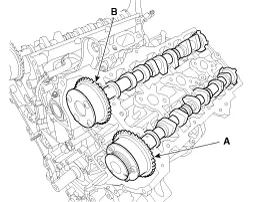
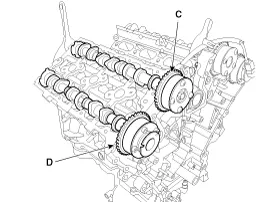
Remove the CVVT assembly.
|

| Inspection |
Continuously variable valve timing (CVVT) Assembly
| 1. |
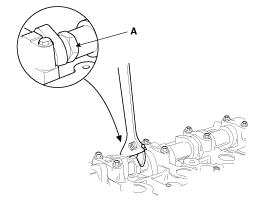
Clamp the camshaft using a vise. Be careful not to damage the cam lobes and journals while using the vise. |
| 2. |
Check that the CVVT is locked by turning it clockwise or counterclockwise. It is normal that the CVVT does not rotate. |
| 3. |
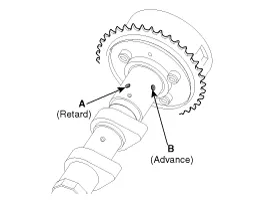
Intake CVVT : Seal one of the two advance holes in the camshaft journal with tape.
Exhaust CVVT : Seal one of the two retard holes in the camshaft journal with tape.
[Intake]
[Exhaust]
|
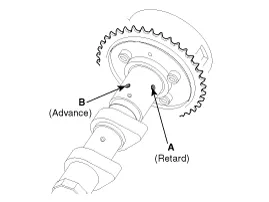
| 4. |
Intake CVVT : Apply approx. 150 kPa (1.5 kgf/cm?, 21 psi )
of compressed air into the unsealed advance hole to release the lock.
Exhaust CVVT : Apply approx. 150 kPa (1.5 kgf/cm?, 21 psi )
of compressed air into the unsealed retard hole to release the lock.
|

| 5. |
Intake CVVT : With compressed air applied, rotate the CVVT
into the advance direction (counterclockwise) within its phasing range
and check that the CVVT turns smoothly.
Exhaust CVVT : With compressed air applied, rotate the CVVT
into the retard direction (clockwise) and check that the CVVT turns
smoothly.
Description Continuous Variable Valve Timing (CVVT) system advances or retards the valve timing of the intake and exhaust valve in accordance with the ECM control signal which is calculated by the engine speed and load. Components 1. RH Exhaust camshaft2. RH Intake camshaft3. LH Intake camshaft4. LH Exhaust camshaft Other information:Hyundai Genesis (DH) 2013-2016 Service Manual: Components and Components LocationC Hyundai Genesis (DH) 2013-2016 Service Manual: Blower Motor Repair proceduresInspection 1. Connect the battery voltage and check the blower motor rotation. 2. If the blower motor does not operate well, replace it with a genuine blower motor check for proper operation. 3. Replace the blower motor if it is proved that there is a problem with it. Categories

Copyright В© 2026 www.hgenesisdh.com - 0.0341
|