
Hyundai Genesis (DH): ESC(Electronic Stability Control) System / Schematic Diagrams
| Circuit Diagram |
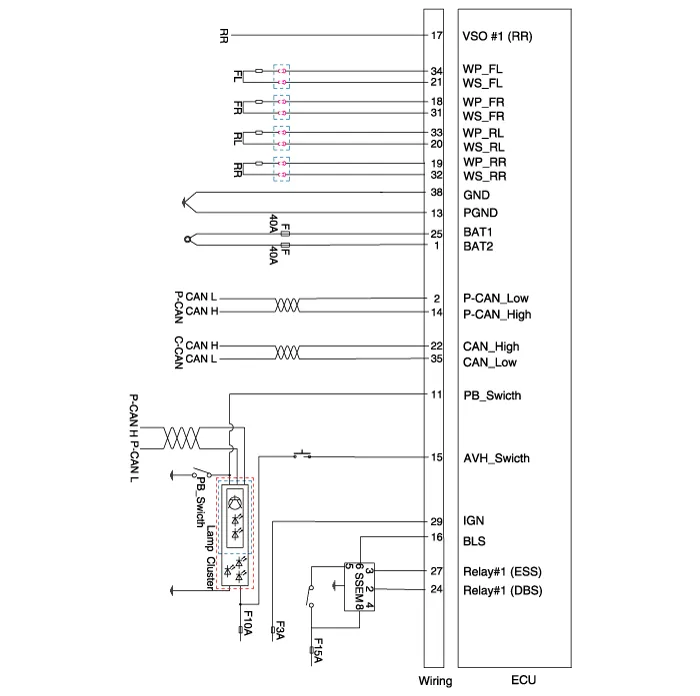
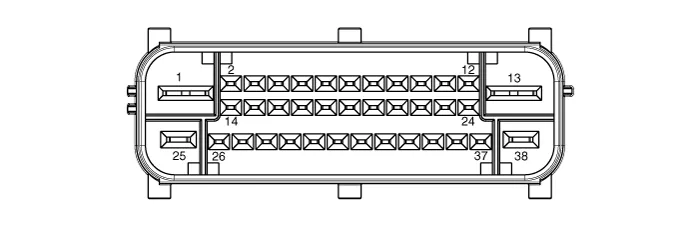
| Pin No | Description | Current(m/A) | Resistance(m/?) | |
| MAX | ||||
| 1 | Battery 2 (+) | 137 | 10 | |
| 2 | POWERTRAIN CAN LOW | 30 | 250 | |
| 3 | - | - | - | |
| 4 | - | - | - | |
| 5 | - | - | - | |
| 6 | - | - | - | |
| 7 | - | - | - | |
| 8 | - | - | - | |
| 9 | - | - | - | |
| 10 | - | - | - | |
| 11 | Parking brake switch | 10 | 250 | |
| 12 | - | - | - | |
| 13 | Ground | 137 | 10 | |
| 14 | POWERTRAIN CAN HIGH | 30 | 250 | |
| 15 | Auto Hold Switch | 10 | 250 | |
| 16 | Stop Lamp Switch | 10 | 250 | |
| 17 | Wheel speed sensor output | 16 | 250 | |
| 18 | Front wheel Sensor power RH | 30 | 250 | |
| 19 | Rear wheel Sensor power RH | 30 | 250 | |
| 20 | Rear wheel Sensor signal LH | 16.8 | 250 | |
| 21 | Front wheel Sensor signal LH | 16.8 | 250 | |
| 22 | C-CAN HIGH | 30 | 250 | |
| 23 | - | - | - | |
| 24 | DBC/HAC relay control | 250 | 250 | |
| 25 | Battery 1 (+) | 40 | 10 | |
| 26 | - | - | - | |
| 27 | ESS relay control | 250 | 250 | |
| 28 | - | - | - | |
| 29 | HECU (IGN) | 50 | 60 | |
| 30 | - | - | - | |
| 31 | Front wheel Sensor signal RH | 16.8 | 250 | |
| 32 | Rear wheel Sensor signal RH | 16.8 | 250 | |
| 33 | Rear wheel Sensor power LH | 30 | 250 | |
| 34 | Front wheel Sensor power LH | 30 | 250 | |
| 35 | C-CAN LOW | 30 | 250 | |
| 36 | - | - | - | |
| 37 | - | - | - | |
| 38 | Ground | 40 | 10 |
Description of ESC ESC recognizes critical driving conditions, such as panic reactions in dangerous situations, and stabilizes the vehicle by braking by wheel and engine control intervention.
Failure Diagnosis 1. In principle, ESC and TCS controls are prohibited in case of ABS failure. 2. When ESC or TCS fails, only the failed system control is prohibited.
Other information:
Hyundai Genesis (DH) 2013-2016 Service Manual: Auto Light Sensor Repair procedures
Removal 1. Disconnect the negative (-) battery terminal. 2. Remove the photo & auto light sensor. (Refer to Windshield Wiper/Washer - "Rain Sensor") Installation 1. Install the auto light sensor. 2. Connect the negative (-) battery terminal.
Hyundai Genesis (DH) 2013-2016 Service Manual: General Safety Information and Caution
Instructions When Handling Refrigerant 1. R-134a liquid refrigerant is highly volatile. A drop on the skin of your hand could result in localized frostbite. When handling the refrigerant, be sure to wear gloves. 2. It is standard practice to wear goggles or glasses to protect your eyes, and gloves to protect your hands.
Categories
- Manuals Home
- Hyundai Genesis Owners Manual
- Hyundai Genesis Service Manual
- Description and Operation
- Active Air Flap(AAF) Repair procedures
- General Information
- New on site
- Most important about car
