
Hyundai Genesis (DH): Airbag Module / Passenger Airbag (PAB) Module Repair procedures
Hyundai Genesis (DH) 2013-2016 Service Manual / Restraint / Airbag Module / Passenger Airbag (PAB) Module Repair procedures
| Removal |
| 1. |
Disconnect the battery negative cable and wait for at least three minutes before beginning work. |
| 2. |
Remove the crash pad.
(Refer to Body - "Crash Pad" ) |
| 3. |
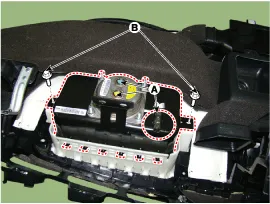
Disconnect the passenger airbag connector (A) and remove the mounting bolts (B).
|

| Installation |
| 1. |
Disconnect the battery negative cable from battery and wait for at least three minutes before beginning work. |
| 2. |
Place a passenger airbag on the crash pad and tighten the passenger airbag mounting bolts(2) (A).
|
| 3. |
Install the crash pad.
(Refer to Body - "Main Crash Pad Assembly") |
| 4. |
Tighten the passenger airbag mounting bolts (B) and Attach the connector to the airbag module (A).
|
| 5. |
install theGlove box housing
(Reper Body - "Glove Box" ) |
| 6. |
Reconnect the battery cable(-) |
| 7. |
After installing the passenger airbag, confirm proper system operation:
Turn the ignition switch ON; the SRS indicator light should turn on for about six seconds and then go off. |
Description The Side Airbags (SAB) are installed inside the front seat and protects the driver and passenger from danger when a side crash occurs.
Other information:
Hyundai Genesis (DH) 2013-2016 Service Manual: Blind Spot Detection Unit Repair procedures
Removal 1. Disconnect the negative (-) battery terminal. 2. Remove the rear bumper. (Refer to Body - "Rear Bumper") 3. Remove the BSD unit (A) after loosening the mounting nuts. Take care not to separate the bracket from rear bumper when removing the BSD sensor.
Hyundai Genesis (DH) 2013-2016 Service Manual: Receiver-Drier Repair procedures
Replacement 1. Remove the condenser. 2. Remove the cap (B) on the bottom of the condenser with the L wrench (A). Tightening torque : 9.81 ~ 14.71 N.m (1.0 ~ 1.5 kgf.m, 7.2 ~ 10.8 lb-ft) 3. Remove the receiver-drier (A) from condenser using a long nose plier.
Categories
- Manuals Home
- Hyundai Genesis Owners Manual
- Hyundai Genesis Service Manual
- Description and Operation
- Repair procedures
- Restraint
- New on site
- Most important about car

Copyright В© 2026 www.hgenesisdh.com - 0.024