
Hyundai Genesis (DH): Fuel Delivery System / Fuel Pump Control Module (FPCM) Description and Operation
| Description |

| Operation |
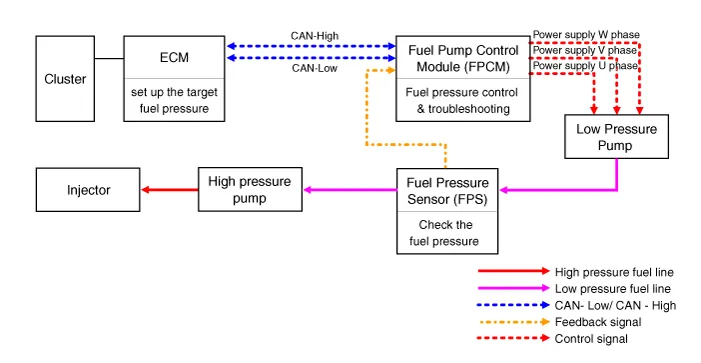
| 1. |
The ECM receives the target fuel pressure signal through CAN communication with the FPCM. |
| 2. |
The FPS applies the current low fuel pressure value to the FPCM. |
| 3. |
The FPCM controls the 3-phase duty function of the low pressure fuel pump. |
| 4. |
The FPS applies the current low fuel pressure value to the FPCM. |
| 5. |
It controls the low pressure fuel pump based on the RPM and vehicle load to provide a consistent flow rate. |
Removal 1. Turn the ignition switch OFF and disconnect the battery negative (-) cable. 2. Release the residual pressure in fuel line. (Refer to Fuel Delivery System -"Release Residual Pressure in Fuel Line")
Specification ltemSpecificationSupply Voltage (V)8~18Supply Current (A)Max. 10Fuel Pressure (kpa)Starting600Drive350 ~ 500Stop20 Under
Other information:
Hyundai Genesis (DH) 2013-2016 Service Manual: Description and Operation
System Overview RPAS (Rear Parking Assist System) is an electronic driving aid that warns the driver to be cautious while parking or driving at low speed. The sensor uses ultrasonic waves to detect objects within proximity of the vehicle. RPAS consists of four RPS sensors which are detecting the obstacles and transmit the result separat
Hyundai Genesis (DH) 2013-2016 Service Manual: CO2 Sensor Description and Operation
Description This system maintains the density of carbon dioxide constantly in vehicle interior by measuring the amount of carbon dioxide to increase the comfortableness and the fuel consumption rate when air conditioning system is operating.
Categories
- Manuals Home
- Hyundai Genesis Owners Manual
- Hyundai Genesis Service Manual
- Transmission Control Module (TCM) Repair procedures
- Evaporative Emission Control System
- Description and Operation
- New on site
- Most important about car
