
Hyundai Genesis (DH): ESC(Electronic Stability Control) System / EBD(Electronic Brake-force Distribution) Description and Operation
Hyundai Genesis (DH) 2013-2016 Service Manual / Brake System / ESC(Electronic Stability Control) System / EBD(Electronic Brake-force Distribution) Description and Operation
| Operation |
The EBD system (Electronic Brake force Distribution) as a
sub-system of the ABS system is to control the maximum braking
effectiveness by the rear wheels.
It further utilizes the efficiency of highly developed ABS
equipment by controlling the slip of the rear wheels in the partial
braking range.
The brake force moves closer to the optimum and is controlled
electronically, thus being dispensed with the need for the
proportioning valve.
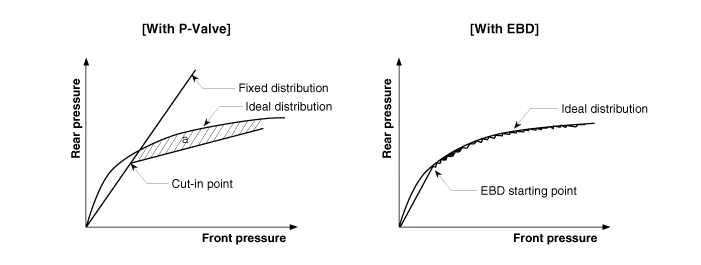
The proportioning valve, because of a mechanical device, has
limitations in achieving an ideal brake force distribution to the rear
wheels as well as carrying out the flexible brake force distribution
proportioning to the vehicle load or weight increasing. And in the event
of malfunctioning, drivers cannot notice the failure.
EBD controlled by the ABS Control Module, calculates the slip
ratio of each wheel at all times and controls the brake pressure of the
rear wheels not to exceed that of the front wheels.
If the EBD fails, the EBD warning lamp (Parking brake lamp) lights up.
Advantages
| - |
Function improvement of the base-brake system. |
| - |
Compensation for the different friction coefficients. |
| - |
Elimination of the proportioning valve. |
| - |
Failure recognition by the warning lamp. |
Comparison between Proportioning Valve and EBD
Failure Diagnosis 1. In principle, ESC and TCS controls are prohibited in case of ABS failure. 2. When ESC or TCS fails, only the failed system control is prohibited.
Removal 1. Turn ignition switch OFF and disconnect the negative (-) battery cable. 2. Remove the Engine room fuse & relay box (B) after removing the cover (A).
Other information:
Hyundai Genesis (DH) 2013-2016 Service Manual: Auto Light Sensor Repair procedures
Removal 1. Disconnect the negative (-) battery terminal. 2. Remove the photo & auto light sensor. (Refer to Windshield Wiper/Washer - "Rain Sensor") Installation 1. Install the auto light sensor. 2. Connect the negative (-) battery terminal.
Hyundai Genesis (DH) 2013-2016 Service Manual: Compressor Components and Components Location
C
Categories
- Manuals Home
- Hyundai Genesis Owners Manual
- Hyundai Genesis Service Manual
- Body Electrical System
- Electric Parking Brake (EPB) Repair procedures
- Starter Repair procedures
- New on site
- Most important about car

Copyright В© 2026 www.hgenesisdh.com - 0.0267