
Hyundai Genesis (DH): Windshield Wiper/Washer / Front Washer Motor Repair procedures
Hyundai Genesis (DH) 2013-2016 Service Manual / Body Electrical System / Windshield Wiper/Washer / Front Washer Motor Repair procedures
| Inspection |
Front Washer Motor
| 1. |
With the washer motor connected to the reservoir tank, fill the reservoir tank with water.
|

| 2. |
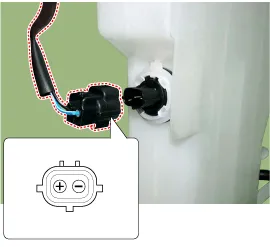
Connect positive (+) battery cables to terminal 2 and negative (-) battery cables to terminal 1 respectively. |
| 3. |
Check that the motor operates normally and the washer motor runs and water sprays from the front nozzles. |
| 4. |
If they are abnormal, replace the washer motor.
[Front & Rear washer]
|
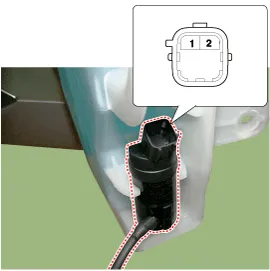
Washer Fluid Level Sensor Switch
| 1. |
Disconnect the negative(-) battery terminal. |
| 2. |
Drain the washer tank until the washer fluid is less than 650cc. |
| 3. |
Check for continuity between the No. 1 and No.2 terminal in each float position.
There should be continuity when the float is down.
There should be no continuity when the float is up. |
| 4. |
If the continuity is not as specified, replace the washer fluid level switch
|

| Removal |
|

| 1. |
Disconnect the negative (-) battery terminal. |
| 2. |
Remove the right wheel house cover. |
| 3. |
Remove the hose (A) for washer reservoir inlet removal.
|
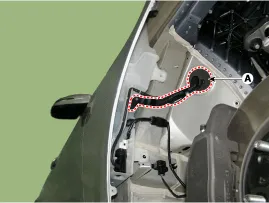
| 4. |
Disconnect the connector (A).
|
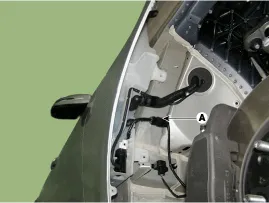
| 5. |
Remove the reservoir washer inlet (A) after loosening the mounting bolt.
|
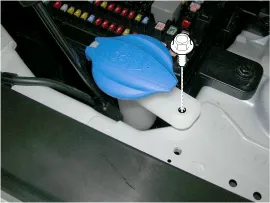
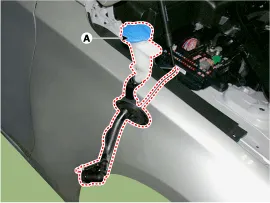
| 6. |
loosening the mounting bolt (A).
|
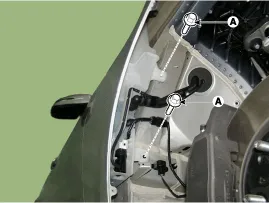
| 7. |
Remove the washer reservoir. |
| 8. |
Remove the head lamp washer hose (A)
|
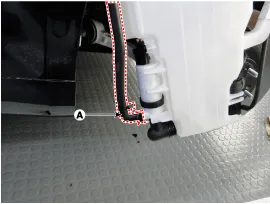
| 9. |
Disconnect the washer motor connector (A) and level sensor connector (B).
|
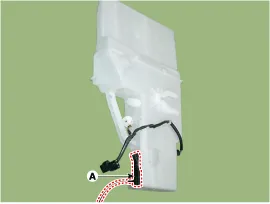
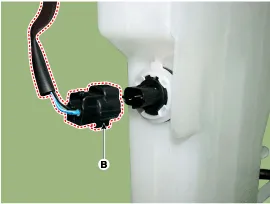
| 10. |
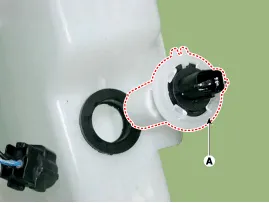
Remove the washer motor and level sensor switch (B).
|
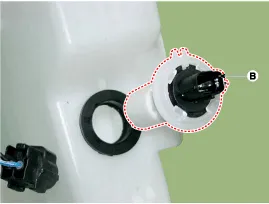
| Installation |
| 1. |
Reassemble the washer reservoir.
|
| 2. |
Install the washer reservoir. |
| 3. |
Connect the washer motor connector and washer hose. |
| 4. |
Reassemble the right wheel house cover. |
Removal 1. Disconnect the negative (-) battery terminal. 2. Remove the windshield wiper arm (A) and blade after removing a nut. 3. If necessary of removing the wiper blade, push both sides of wiper tabs (A) and then remove the wiper blade.
Removal Head Lamp Washer Motor - When servicing the washer pump, be careful not to damage the washer pump seal. - Do not operate the washer pump before filling the washer reservoir.
Other information:
Hyundai Genesis (DH) 2013-2016 Service Manual: Description and Operation
D
Hyundai Genesis (DH) 2013-2016 Service Manual: Compressor Repair procedures
Removal 1. If the compressor is marginally operable, run the engine at idle speed, and let the air conditioning work for a few minutes, then shut the engine off. 2. Disconnect the negative (-) battery terminal. 3. Remove the engine room cover.
Categories
- Manuals Home
- Hyundai Genesis Owners Manual
- Hyundai Genesis Service Manual
- Components and Components Location
- Active Air Flap(AAF) Repair procedures
- Description and Operation
- New on site
- Most important about car

Copyright В© 2026 www.hgenesisdh.com - 0.0337