
Hyundai Genesis (DH): Automatic Transmission Control System / Description and Operation
Hyundai Genesis (DH) 2013-2016 Service Manual / Automatic Transmission System (SBC) / Automatic Transmission Control System / Description and Operation
| Description |
Automatic transmission system relies on various measurement
data to determine the current control status and extrapolate the
necessary compensation values. These values are used to control the
actuators and achieve the desired control output. If a problem with the
drivetrain, including the transmission, has been identified, perform
self-diagnosis and basic transmission inspection (oil and fluid
inspection) and then check the control system's components using the
diagnosis tool.
| Control System Composition |
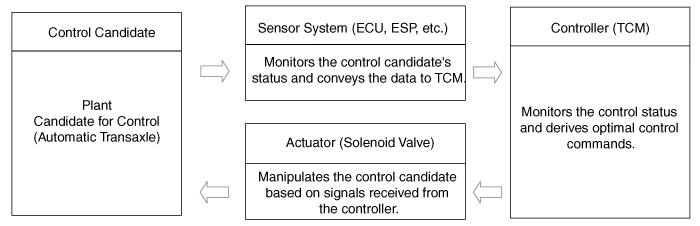
| Fault Diagnosis |
It features a fail-safe mechanism that allows a vehicle to be driven home or to a dealer in the event of a transmission failure.
The limp home mode is engaged if the transmission
malfunctions. In this mode, the transmission operates at a minimal
functionality level, making it possible for the vehicle to reach a
service center.
Fail-Safe: Allows the vehicle to be driven safely in the event of a malfunction.
Limp Home: Maintains minimal functionality (*) in the event
of a malfunction, making it possible for the vehicle to reach a service
center.
(*) Minimal Functionality: Drive (fixed gear setting), Reverse, and Neutral
| Self-diagnosis |
TCM is in constant communication with the control system's
components (sensors and solenoids). If an abnormal signal is received
for longer than the predefined duration, TCM recognizes a fault, stores
the fault code in memory, and then sends out a fault signal through the
self-diagnosis terminal. Such fault codes are independently backed up
and will not be cleared even if the ignition switch is turned off, the
battery is disconnected, or the TCM connector is disconnected.
Adjustment TCM Learning When shift shock occurs or parts related with the transmission are replaced, TCM learning should be performed. In the following case, TCM learning is required. Other information:Hyundai Genesis (DH) 2013-2016 Service Manual: High Mounted Stop Lamp Repair proceduresRemoval High Mounted Stop Lamp 1. Disconnect the negative (-) battery terminal. 2. Remove the roof trim assembly. (Refer to Body - "Roof Trim") 3. Remove the high mounted stop lamp assembly (A) after loosening the mounting screws. Installation 1. Hyundai Genesis (DH) 2013-2016 Service Manual: Condenser Repair proceduresInspection 1. Check the condenser fins for clogging and damage. If they are clogged, clean them with water, and blow them with compressed air. If they are bent, gently bend them using a screwdriver or pliers. 2. Check the condenser connections for leakage, and repair or replace it, if required. Categories

Copyright В© 2026 www.hgenesisdh.com - 0.0186
|
