
Hyundai Genesis (DH): Brake System / Brake Line Repair procedures
Hyundai Genesis (DH) 2013-2016 Service Manual / Brake System / Brake System / Brake Line Repair procedures
| Removal |
| 1. |
Disconnect the brake fluid level switch connector, and remove the reservoir cap. |
| 2. |
Remove the brake fluid from the master cylinder reservoir with a syringe. |
| 3. |
Remove the wheel & tire. |
| 4. |
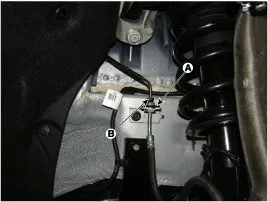
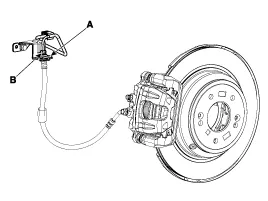
Disconnect the brake hose clip (A) and then remove the brake tube by loosening the tube flare nut (B).
[Front]
[Rear]
|
| 5. |
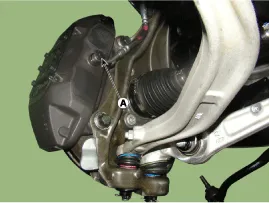
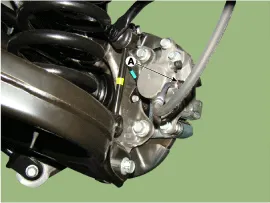
Disconnect the brake hose from the brake caliper by loosening the bolt (A).
[Front]
[Rear]
|
| Inspection |
| 1. |
Check the brake tubes for cracks, crimps and corrosion. |
| 2. |
Check the brake hoses for cracks, damage and fluid leakage. |
| 3. |
Check the brake tube flare nuts for damage and fluid leakage. |
| 4. |
Check brake hose mounting bracket for crack or deformation. |
| Installation |
| 1. |
To install, reverse the removal procedure.
|

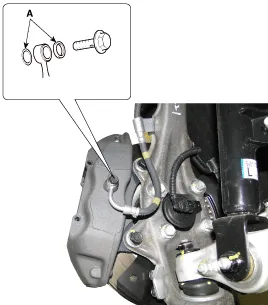
| 2. |
After installation, bleed the brake system.
(Refer to Brake System - "Brake System Bleeding") |
| 3. |
Check for brake fluid leaks. |
Components 1. Brake pedal member assembly2. Stop lamp switch3. Clevis pin4. Snap pin5. Brake pedal stopper6. Return spring7. Bolt
Other information:
Hyundai Genesis (DH) 2013-2016 Service Manual: Rear Combination Lamp Repair procedures
Removal 1. Disconnect the negative (-) battery terminal. 2. After loosening the nuts (4EA) holding the rear combination lamp and disconnecting the connector (A), remove the outside rear combination lamp assembly. 3. Remove the bulb (A) after turning it in the counter clock-wise direction.
Hyundai Genesis (DH) 2013-2016 Service Manual: Cluster Ionizer Repair procedures
Inspection 1. Press the MODE switch more than 4 times within 2 seconds while pressing the OFF switch. DisplayFail description00Normal51Cluster ion generator fault * For diagnostic procedure, refer to DTC guide. Replacement 1. Disconnect the negative (-) battery terminal.
Categories
- Manuals Home
- Hyundai Genesis Owners Manual
- Hyundai Genesis Service Manual
- Suspension System
- Active Air Flap(AAF) Repair procedures
- Electric Parking Brake (EPB) Repair procedures
- New on site
- Most important about car

Copyright В© 2026 www.hgenesisdh.com - 0.0283